
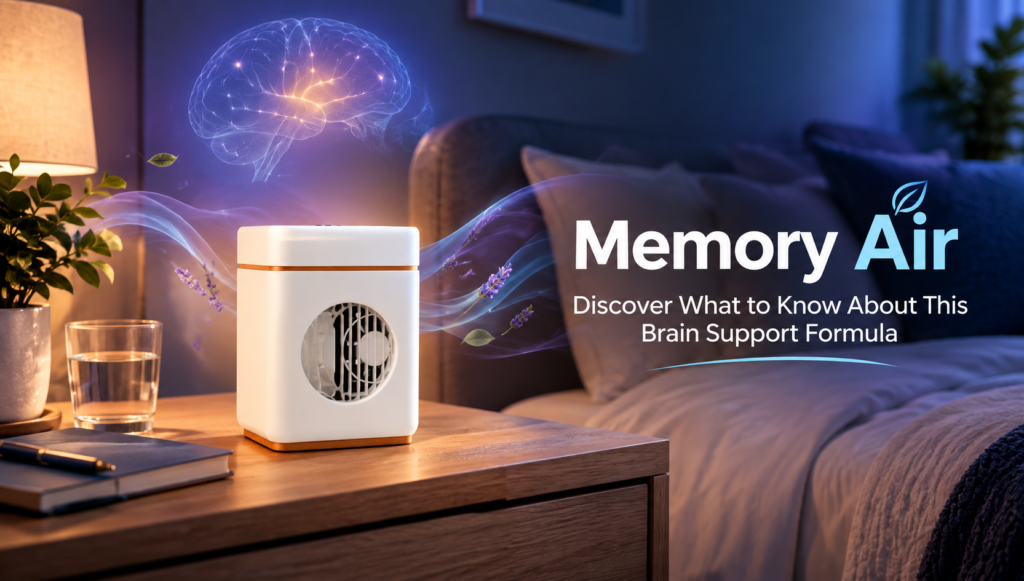
What if supporting your memory didn’t involve another pill, powder, or complicated daily routine?
That’s the idea behind Memory Air, a brain-health device that uses carefully timed scent stimulation while you sleep. Unlike conventional memory supplements, Memory Air is built around olfactory enrichment—the practice of exposing the brain to a variety of scents to stimulate the olfactory system.
The concept may sound unusual at first. After all, we normally think about memory in terms of sleep, exercise, nutrition, puzzles, or supplements. But researchers at the University of California, Irvine have been investigating the connection between smell, the brain, and memory for years. A 2023 study involving 43 adults ages 60 to 85 found that nighttime olfactory enrichment was associated with a statistically significant improvement in performance on a standardized verbal memory test.
So, what exactly is Memory Air, how does it work, and what should you know before considering it?
Let’s take a closer look.
What Is Memory Air?
Memory Air is a bedside scent-delivery device designed to provide olfactory stimulation during sleep. It isn’t a conventional dietary supplement, prescription medication, or ordinary aromatherapy diffuser.
The device sits beside your bed and uses replaceable scent belts containing multiple scent stimuli. According to the manufacturer, the current system delivers 40 unique scent stimuli in a rotating sequence, with a new scent belt supplied monthly through its membership program.
The basic idea is simple: while you’re asleep, Memory Air introduces carefully selected scents into your environment at programmed intervals.
The company describes this as olfactory enrichment, rather than simply making your bedroom smell pleasant.
That distinction matters.
A traditional essential-oil diffuser might continuously release lavender or another fragrance. Memory Air is designed around variety and sequencing because its approach is intended to repeatedly stimulate the olfactory system with different scents.
The goal isn’t simply relaxation or creating a nice-smelling bedroom. The product is designed to support memory, sleep, mood, and cognitive health through repeated olfactory stimulation.
How Does Memory Air Work?
To understand Memory Air, it’s useful to start with the relationship between smell and memory.
Your sense of smell is closely connected with areas of the brain involved in memory and emotion. Odor information travels through the olfactory system to brain regions involved in processing memories and emotional associations.
That’s one reason a particular smell can suddenly remind you of a childhood home, a vacation, a person, or a specific moment from years ago.
Researchers have been interested in whether this connection can be deliberately stimulated.
Memory Air is based on that research.
Rather than asking users to consciously smell different bottles throughout the day, the device automates the process. You place it near your bed, insert the scent belt, start the device, and allow it to operate according to its programmed schedule.
According to Memory Air’s current instructions, the device is designed to begin dispensing its scent sequence about an hour after bedtime and then operate automatically.
Why Does Smell Matter for Memory?
The connection between smell and memory isn’t a new discovery.
Most people have experienced it personally. A familiar perfume can remind you of someone instantly. The smell of a particular food can bring back memories from childhood. Even the scent of a hotel lobby can remind you of a previous trip.
Neuroscience helps explain why these experiences can feel so immediate.
The olfactory system has direct connections with brain regions involved in memory and emotion. This makes smell different from many other sensory experiences.
The researchers behind the olfactory-enrichment approach wanted to know whether deliberately stimulating this system could influence cognitive performance.
That’s where the research behind Memory Air becomes particularly interesting.
The Science Behind Memory Air
One of the most important studies associated with the technology was published in Frontiers in Neuroscience in 2023.
Researchers from the University of California, Irvine studied 43 healthy adults between ages 60 and 85. Participants were randomly assigned to either an olfactory-enrichment group or a control group.
The enriched group was exposed to seven different odorants, one per night, for two hours while sleeping. The control group experienced the same setup but received only minimal amounts of odorant.
After six months, researchers assessed participants using neuropsychological testing and brain imaging.
The study reported a statistically significant 226% improvement compared with the control group on the Rey Auditory Verbal Learning Test, along with changes in the left uncinate fasciculus, a white-matter pathway involved in communication between brain regions.
The findings were notable enough to attract considerable attention from researchers and the public.
UC Irvine described the study as showing a substantial improvement in cognitive performance after nightly exposure to fragrances.
What Does the 226% Figure Actually Mean?
This is an important point when reading about Memory Air.
The 226% figure shouldn’t be interpreted as meaning that every person who uses Memory Air will suddenly have 226% better memory.
It refers to the difference reported between the enriched and control groups on a particular memory test in this specific study.
The study was relatively small, involving only 43 participants, and the participants were healthy older adults without diagnosed cognitive impairment or dementia.
In other words, the research is interesting, but it shouldn’t be turned into a promise that every user will experience the same result.
That’s an important distinction when evaluating any product based on emerging cognitive research.
Memory Air Is Not a Traditional Memory Supplement
Despite being marketed as a brain-support product, Memory Air isn’t a capsule or dietary supplement.
There are no pills to swallow and no ingredient label resembling the one you’d find on a typical nootropic product.
Instead, the product consists of a small electronic device and scent belts.
According to the manufacturer’s current product information, the device is approximately 5.5 inches wide and 5.5 inches deep and operates from a power connection rather than a battery.
The scent belt is the consumable part.
The current product page says each belt contains 40 unique scent stimuli and is designed to provide approximately 30 nights of use.
That means the ongoing cost isn’t limited to buying the device itself. Anyone considering Memory Air should also understand the replacement-belt or membership model.
What Does a Memory Air Routine Look Like?
One appealing aspect of Memory Air is how little effort is required from the user.
The basic routine looks something like this:
- Place the device beside your bed.
- Insert the current scent belt.
- Press the start button when beginning your nighttime routine.
- Go to sleep.
- Allow the device to operate automatically.
- Replace the scent belt when the next one arrives.
Memory Air says the device doesn’t require the start button to be pressed every night after the initial setup. The system remembers the schedule and operates automatically.
The company recommends placing the device on the side of the bed you face while sleeping. If you normally sleep on your back, either side can be used.
That simplicity is clearly part of the product’s design.
There’s no complicated exercise routine, no daily supplement organizer, and no need to remember a sequence of scents yourself.
Memory Air vs. Aromatherapy
At first glance, Memory Air can sound similar to aromatherapy.
Both involve scents, and both can involve essential oils or fragrant compounds. But the intended purpose and delivery method are different.
Traditional aromatherapy generally focuses on using particular scents for experiences such as relaxation, mood, or creating a pleasant environment.
Memory Air’s approach is based on olfactory enrichment.
The emphasis is on exposing the olfactory system to a variety of novel scents in a structured sequence rather than simply filling a room with one continuous fragrance.
The company specifically distinguishes Memory Air from conventional aromatherapy because the device is designed around repeated exposure to multiple scents.
That doesn’t mean every aroma diffuser will produce the same effects as Memory Air.
The research supporting the concept used a specific protocol involving multiple scents and controlled exposure. A standard diffuser operating continuously with one favorite essential oil isn’t necessarily equivalent to that experimental setup.
What Scents Does Memory Air Use?
The exact scent experience is one of the more unusual parts of the product.
Memory Air’s current product page says its scent belt contains 40 unique scent stimuli intended for olfactory enrichment rather than simply functioning as room fragrance.
The manufacturer’s earlier descriptions have also emphasized rotating natural scents and novelty.
This variety is important to the underlying concept.
The goal isn’t necessarily to find one “best” smell for memory. Instead, the idea is to repeatedly challenge and stimulate the olfactory system with different scents.
That’s different from buying one bottle of lavender oil and leaving a diffuser running beside your bed every night.
What Are the Potential Benefits of Memory Air?
Memory Air is designed around several areas of brain health.
The manufacturer currently highlights:
- Memory support
- Sleep support
- Mental clarity
- Mood support
- Long-term cognitive health
The research provides evidence that nighttime olfactory enrichment can affect cognitive performance and certain brain measures in older adults.
The study also reported that participants experienced improved sleep quality, while brain imaging showed changes involving the left uncinate fasciculus.
However, it’s useful to separate research findings from product-specific expectations.
A scientific study investigating an olfactory-enrichment protocol isn’t automatically proof that every commercial implementation produces identical results.
That’s why prospective buyers should look at both the research and the actual product specifications.
Who Might Be Interested in Memory Air?
Memory Air may attract several types of people.
Older Adults Interested in Brain Health
The strongest directly relevant human study involved adults ages 60 to 85 without diagnosed memory impairment.
That makes older adults particularly relevant when discussing the research behind the technology.
Someone interested in maintaining cognitive health may be curious about a non-pill-based approach that can become part of a nightly routine.
People Interested in Non-Drug Approaches
Some people prefer wellness strategies that don’t involve taking another supplement or medication.
Memory Air is designed as a non-invasive sensory approach, using scent stimulation rather than ingesting an active ingredient.
People Who Want a Low-Effort Routine
Consistency is often one of the hardest parts of any wellness routine.
A complicated routine can quickly become another task on your to-do list.
Memory Air is designed to operate automatically after setup, which may appeal to people who want something that fits naturally into their bedtime routine.
How Much Does Memory Air Cost?
Price is an important consideration because Memory Air involves both an initial device purchase and ongoing scent-belt costs.
At the time of research for this article, the official Memory Air product page listed the device at $399, with subscription options beginning at $49 per month or an annual option listed at $492 per year. The company’s product listings also show standalone Memory Air refills priced at $39.
Pricing can change, so it’s worth checking the official store before purchasing.
The important point is to calculate the total cost of ownership, rather than looking only at the initial device price.
Ask yourself:
- What is the upfront device cost?
- How much do replacement scent belts cost?
- Is a subscription required?
- How frequently are refills shipped?
- Can the membership be canceled?
- Are shipping costs included?
- What is the current return or trial policy?
The official product page currently advertises free shipping and a 60-day guarantee, while its membership information says subscriptions can be canceled.
Is Memory Air FDA Approved?
This is another point worth understanding before purchasing.
Memory Air’s own product information states that the device is a general wellness device for mental acuity and is not a medical device cleared by the FDA. It also states that the product isn’t intended to diagnose, treat, cure, or prevent disease.
That’s significant because marketing language around brain health can sometimes make a wellness product sound like a medical treatment.
Memory Air should therefore be understood in the context of its intended wellness use and the research supporting olfactory enrichment—not as a replacement for medical evaluation or treatment.
What Does the Research Tell Us—and What Doesn’t It Tell Us?
The 2023 UC Irvine study is certainly interesting.
It was randomized, used a control group, included brain imaging, and was published in a peer-reviewed scientific journal.
At the same time, there are limitations worth keeping in mind.
The study included only 43 participants. They were healthy adults between 60 and 85 years old without diagnosed cognitive impairment or dementia. The intervention also followed a specific protocol involving seven odorants delivered for two hours per night.
That means you shouldn’t automatically assume the findings apply equally to:
- Younger adults
- People with diagnosed dementia
- People with neurological conditions
- People using different scent combinations
- People using a different duration or schedule
- People who respond differently to odors
The research supports continued interest in olfactory enrichment, but additional research can help clarify how broadly the findings apply.
Memory Air and Sleep
Sleep and memory are closely connected.
During sleep, the brain performs processes involved in memory consolidation and recovery. That’s one reason poor sleep can leave you feeling mentally sluggish the following day.
Memory Air is designed to operate during sleep rather than requiring conscious participation.
The manufacturer says the device begins its programmed scent delivery after you fall asleep and runs automatically.
The 2023 UC Irvine research also reported improved subjective sleep quality among participants exposed to the enriched scent condition.
Still, it’s useful to distinguish between supporting healthy sleep and treating a sleep disorder.
Someone experiencing persistent insomnia, loud snoring, breathing interruptions, excessive daytime sleepiness, or other concerning symptoms should address those issues separately rather than relying on a wellness device.
Is Memory Air Easy to Use?
Compared with many daily wellness products, the setup is fairly straightforward.
The device is intended to sit on your nightstand, close to the user’s head. You insert the scent belt, start the device, and let the automated schedule handle the rest.
The manufacturer says its effective scent range reaches up to approximately five feet.
There’s also no filter to clean, according to the company’s FAQ.
The main ongoing task is replacing the scent belt when necessary.
For someone who likes simple routines, that’s a relatively low-maintenance approach.
Things to Consider Before Buying Memory Air
Memory Air is an interesting product, but it isn’t necessarily the right choice for everyone.
Before buying, consider the following.
Your Expectations
Don’t approach the product expecting an instant transformation.
The research that inspired Memory Air involved repeated exposure over months, not a single night’s use.
Your Budget
Factor in both the device and replacement scent belts.
The ongoing cost matters just as much as the initial purchase price.
Your Sensitivity to Scents
Some people love fragrance. Others develop headaches, irritation, or simply dislike certain smells.
If you are sensitive to fragrances, think carefully about whether a nightly scent-based routine will be comfortable for you.
Your Existing Health Routine
Memory Air shouldn’t be viewed as a substitute for the fundamentals of brain health.
Regular physical activity, adequate sleep, a balanced diet, social engagement, mental stimulation, and management of cardiovascular risk factors are all important components of overall health.
A device can be part of a routine without being the entire routine.
Memory Air: A Different Approach to Brain Support
The biggest thing that sets Memory Air apart from traditional brain-health products is its delivery method.
You’re not swallowing a capsule.
You’re not solving a puzzle every morning.
You’re not trying to remember which supplement you took.
Instead, Memory Air uses a bedside device to deliver a rotating sequence of scents while you sleep.
The concept comes from research into the relationship between the olfactory system and memory, including the 2023 UC Irvine study that reported significant improvements on a verbal memory test after six months of nighttime olfactory enrichment in healthy older adults.
That’s what makes the technology intriguing.
At the same time, the evidence should be viewed carefully. A small study is a starting point for understanding a potential intervention, not a guarantee of identical results for every consumer.
Frequently Asked Questions About Memory Air
1. What is Memory Air?
Memory Air is a bedside olfactory-enrichment device that delivers rotating scent stimuli during sleep to support memory and cognitive wellness.
2. Is Memory Air a supplement?
No. Memory Air is a scent-delivery device, not a dietary supplement, pill, medication, or traditional nootropic formula.
3. How does Memory Air work?
Memory Air releases different scent stimuli in a programmed sequence while you sleep, stimulating the olfactory system without requiring active participation.
4. What research supports Memory Air?
A 2023 UC Irvine study of 43 healthy adults ages 60–85 found significant memory-test improvements following nightly olfactory enrichment.
5. Can Memory Air improve memory?
Research suggests nighttime olfactory enrichment may improve certain memory measures, but individual results can vary considerably between users.
6. How often should Memory Air be used?
The device is designed for regular nighttime use, with automated scent delivery beginning according to its programmed schedule after bedtime.
7. Is Memory Air FDA approved?
The manufacturer states that Memory Air is a general wellness device and is not an FDA-cleared medical device.
8. How much does Memory Air cost?
The official website currently lists the device at $399, with additional costs for ongoing scent-belt subscriptions or replacement refills.
9. Is Memory Air the same as aromatherapy?
No. Memory Air focuses on repeated exposure to multiple scents, while conventional aromatherapy commonly uses selected fragrances for relaxation or atmosphere.
10. Where can you buy Memory Air?
The manufacturer states that Memory Air is sold online through its official website rather than through Amazon or traditional retail stores.
Conclusion: Is Memory Air Worth Exploring?
Memory Air takes an unconventional approach to brain support by focusing on something most of us rarely think about: our sense of smell.
Instead of another capsule or powder, the device uses overnight olfactory enrichment to expose the brain to a rotating variety of scent stimuli while you sleep.
The science behind the concept is compelling enough to deserve attention. A peer-reviewed UC Irvine study involving 43 healthy adults ages 60 to 85 found a statistically significant improvement in performance on a verbal memory test after six months of nightly olfactory enrichment, along with changes in a brain pathway associated with memory.
But the smartest way to approach Memory Air is with realistic expectations.
Look at the research, understand the study population, consider the cost of the device and replacement scent belts, and decide whether an automated nighttime routine fits your lifestyle.
Most importantly, think of Memory Air as one potential component of a broader brain-health routine, rather than a magic solution for memory problems.