
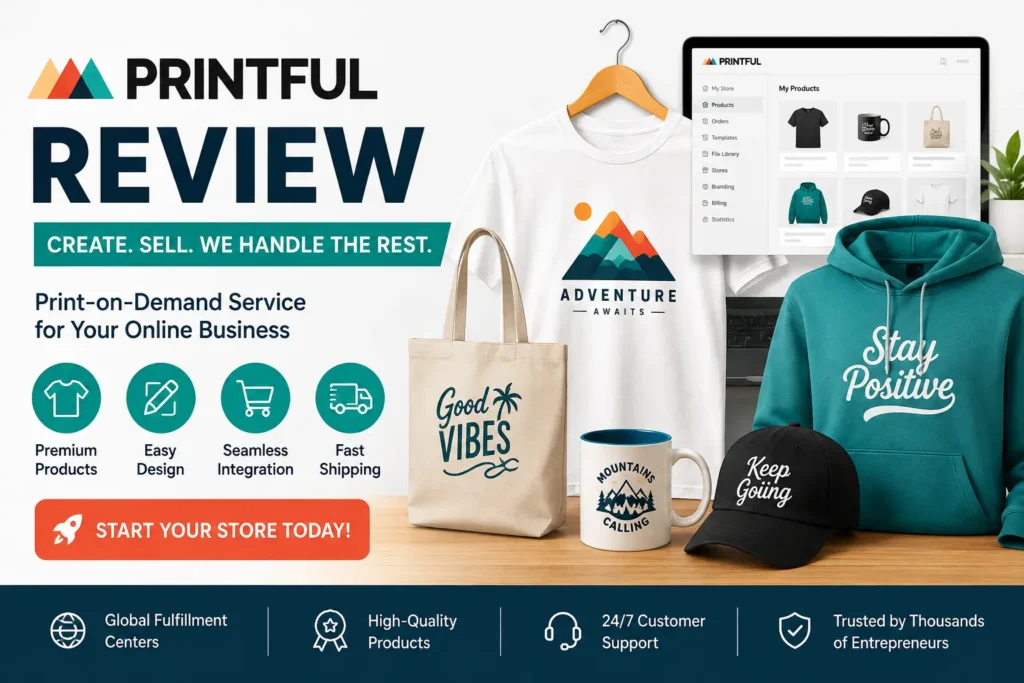
Introduction
Starting an online store can be difficult when you have to buy products, store inventory, pack orders, and manage shipping. Printful offers a simpler approach for people who want to sell custom products online without keeping a large stock at home.
Printful is a print-on-demand and fulfillment platform. Users can create designs and place them on products such as T-shirts, hoodies, mugs, hats, bags, posters, and other items. When a customer places an order, the product can be produced and prepared for delivery.
This model can be useful for creators, artists, influencers, small businesses, and online store owners.
In this detailed Printful review, we will look at how Printful works, its products, customization options, quality, pricing, integrations, shipping, pros and cons, and whether it is worth using.
What Is Printful?
Printful is an online print-on-demand and fulfillment service.
The platform allows users to create custom products without purchasing large quantities in advance. Instead of storing hundreds of products, you can add your designs to selected items and sell them through an online store.
Printful can handle several parts of the order process, including:
- Product printing
- Product preparation
- Order fulfillment
- Packaging
- Shipping
This means store owners can focus more on creating designs, promoting products, and communicating with customers.
How Does Printful Work?
The basic process is simple.
First, you choose a product from the available catalog. Next, you upload your design and customize the product.
After creating the product, you can connect Printful with a supported online selling platform and add the product to your store.
When a customer purchases the product, the order can be sent to Printful for fulfillment.
A simple process looks like this:
Choose Product → Add Design → Create Product → Add to Store → Customer Orders → Printful Fulfills → Product Ships
This approach removes much of the work associated with traditional inventory management.
Main Products Available on Printful
Printful offers a wide variety of products.
T-Shirts
T-shirts are among the most popular print-on-demand products.
You can create designs for:
- Casual T-shirts
- Graphic shirts
- Basic shirts
- Oversized styles
- Different fits
- Different colors
T-shirts are a good starting point for new sellers because they are easy to understand and can work with many types of designs.
Hoodies and Sweatshirts
Hoodies and sweatshirts are useful for seasonal collections and streetwear brands.
They can feature:
- Logos
- Artwork
- Text
- Illustrations
- Brand graphics
Because hoodies can have a higher selling price than basic T-shirts, they may also provide more room for pricing strategies.
Hats
Custom hats can help create a recognizable brand identity.
Depending on the product, customization may include embroidery or printed designs.
Hats can be useful for fashion brands, sports-related businesses, creators, and lifestyle stores.
Bags
Printful also offers different types of bags.
Products may include:
- Tote bags
- Backpacks
- Travel bags
- Accessories
A simple logo or artwork can turn an everyday bag into a branded product.
Mugs
Custom mugs are another popular option.
They can be used for:
- Quotes
- Illustrations
- Business logos
- Personalized designs
- Gift collections
Mugs can be especially useful for seasonal products and gift-focused stores.
Wall Art
Creators can also use Printful for artwork and decorative products.
Depending on the current catalog, options may include:
- Posters
- Canvas-style products
- Framed products
- Other wall decorations
These products can work well for artists and graphic designers.
Customization Options
Customization is one of Printful’s main attractions.
You can upload your own designs and apply them to selected products.
Depending on the product, customization options may include:
- Printing
- Embroidery
- Different product colors
- Placement options
- Product variations
- Personalized text
The available options depend on the specific product.
Before publishing a product, review the design preview carefully to make sure everything is positioned correctly.
Printful Product Quality
Product quality is important for any print-on-demand business.
Printful offers products from different suppliers and product categories, so quality can vary depending on the item.
When evaluating a product, consider:
- Fabric
- Product weight
- Construction
- Print method
- Stitching
- Product fit
- Color
- Durability
A good practice is to order samples before selling a product to customers.
A sample allows you to check the actual product instead of relying only on digital previews.
Print Quality
Print quality can depend on the product, design, material, and printing method.
A high-quality design file usually produces better results.
Before uploading artwork, make sure:
- The image has good resolution.
- Text is readable.
- The design fits the printing area.
- Colors look correct.
- Important details are not too close to the edges.
Following the platform’s design requirements can help prevent unwanted results.
Embroidery
Printful also provides embroidery options for selected products.
Embroidery can work well for:
- Logos
- Small symbols
- Simple graphics
- Brand names
- Text
However, extremely detailed artwork may not always translate well into embroidery.
Simple designs are generally easier to reproduce clearly.
Printful Pricing
Printful uses a product-based pricing model.
The cost can depend on:
- Product type
- Product brand
- Size
- Color
- Customization method
- Printing area
- Embroidery
- Quantity
- Shipping destination
Your profit comes from the difference between your retail price and the total cost involved in producing and delivering the order.
For example, if your total product and fulfillment cost is $20 and you sell the item for $35, the basic difference is $15 before other expenses such as taxes, marketplace fees, advertising, and payment processing.
Because costs can vary, sellers should calculate their complete expenses before setting prices.
Is Printful Free?
Printful has offered ways to start using its platform without paying a traditional monthly membership fee for basic access, while certain features, products, or services can have separate costs.
However, pricing structures and optional programs can change.
Before starting a business, check the current pricing information and calculate the cost of your selected products.
The important point is that print-on-demand is not completely cost-free. You still pay for products and fulfillment when orders are processed.
Profit Margins
Profit margins depend on your pricing strategy.
For example:
Selling Price – Product Cost – Shipping – Platform Fees – Other Expenses = Estimated Profit
A product with a low base cost may not automatically produce a strong profit if shipping, advertising, and marketplace fees are high.
Before launching a product, calculate the complete cost.
Printful Shipping
Shipping is an important part of the customer experience.
Printful fulfills orders and ships products to customers.
Shipping time can vary depending on:
- Product
- Production time
- Destination
- Shipping method
- Order volume
- Holidays
- Current fulfillment conditions
Store owners should avoid promising extremely short delivery times unless they are confident that the product can arrive within that period.
It is better to provide customers with realistic delivery information.
Printful Integrations
One of Printful’s useful features is its ability to connect with online selling platforms.
Depending on current support, integrations may include popular ecommerce platforms and marketplaces.
These connections can make it easier to:
- Publish products
- Receive orders
- Send orders for fulfillment
- Update product information
- Manage store operations
The exact integrations available can change, so sellers should check the current options before selecting a platform.
Printful for Shopify Sellers
Printful can be useful for Shopify store owners who want to sell custom products.
A typical workflow involves:
- Create a Shopify store.
- Connect the store with Printful.
- Choose products.
- Upload designs.
- Create product listings.
- Set prices.
- Publish products.
- Promote the store.
- Receive customer orders.
- Let Printful handle fulfillment.
This setup can reduce the need to manually process every order.
Printful for Etsy Sellers
Print-on-demand can also work well with creative marketplaces such as Etsy.
Artists and designers can create products around specific themes, interests, or audiences.
Examples include:
- Art prints
- T-shirts
- Mugs
- Personalized gifts
- Accessories
- Seasonal products
However, sellers should always follow the marketplace’s current rules regarding production partners, intellectual property, and product listings.
Printful for Beginners
Printful can be beginner-friendly because you do not need to purchase a large amount of inventory before testing a product.
A new seller can start with a small collection and see how customers respond.
A simple beginner strategy is:
- Step 1: Choose a Niche: Pick a specific audience rather than trying to sell everything.
- Step 2: Create Original Designs: Focus on useful, attractive, or entertaining designs.
- Step 3: Select a Few Products: Start with a small number of products.
- Step 4: Order Samples: Check the quality before promoting the products heavily.
- Step 5: Build Your Store: Create clear product pages with useful descriptions.
- Step 6: Set Realistic Prices: Include all costs when calculating your selling price.
- Step 7: Promote Your Products: Use social media, content marketing, email marketing, or paid advertising.
Printful for Artists
Artists can use print-on-demand to turn digital artwork into physical products.
Instead of producing hundreds of items, an artist can make designs available on selected products.
This can include:
- Art prints
- Clothing
- Bags
- Mugs
- Accessories
- Home products
The model allows artists to test different designs without taking on the same inventory risk as traditional manufacturing.
Printful for Small Businesses
Small businesses can also use custom products for branding.
For example, a business could create:
- Branded shirts
- Employee clothing
- Promotional products
- Customer merchandise
- Event products
- Branded accessories
This can be useful when a company wants custom products without managing a large warehouse.
Printful for Creators
Content creators can use Printful to build merchandise around their personal brand.
Possible products include:
- Logo T-shirts
- Hoodies
- Hats
- Mugs
- Bags
- Posters
Creators can use their existing audience to promote products.
The biggest advantage is that the creator does not necessarily need to store or package each order personally.
Customer Experience
The customer’s experience depends on several factors.
These include:
- Product quality
- Print quality
- Packaging
- Shipping time
- Product accuracy
- Store communication
- Return handling
The seller remains responsible for setting expectations and communicating with customers.
Even when Printful handles fulfillment, the store owner should monitor customer feedback and product performance.
Returns and Refunds
Returns can be more complicated with customized products.
Since print-on-demand products are made after an order is placed, sellers should clearly explain their return and refund policies.
Customers should understand what happens if:
- The product arrives damaged.
- The wrong product is delivered.
- The product has a printing problem.
- The customer chooses the wrong size.
- The customer changes their mind.
Policies can depend on the situation and the specific product.
Store owners should review current fulfillment and return policies before creating their own customer policy.
Pros and Cons of Printful
Pros
- No need to hold large inventory
- Easy product customization
- Large product selection
- Useful for beginners
- Supports different ecommerce platforms
- Order fulfillment is handled for you
- Can be used by artists and creators
- Easy way to test new product ideas
- Suitable for small businesses
Cons
- Product costs can be higher than bulk manufacturing.
- Shipping adds to the total cost.
- Profit margins require careful calculation.
- Product quality can vary between products.
- Sellers have less control over fulfillment than with their own warehouse.
- Ordering samples adds an extra cost.
- Popular products can change in availability.
Tips for Using Printful Successfully
Start Small
Do not launch hundreds of products immediately.
Start with a few strong designs and learn what your audience likes.
Order Samples
Seeing and testing the actual product is one of the best ways to understand quality.
Use High-Quality Designs
Poor-quality artwork can reduce the final product quality.
Calculate Everything
Include product cost, shipping, payment fees, marketplace fees, advertising, and other expenses.
Write Clear Product Descriptions
Customers should understand the product, material, size, and expected delivery information.
Focus on a Niche
A focused store can be easier to market than a store that sells unrelated products.
Monitor Customer Feedback
Reviews can help you identify which products are performing well and which need improvement.
Is Printful Worth Using?
Printful can be worth considering if you want to start a print-on-demand business without managing physical inventory.
It is particularly useful for:
- Beginners
- Artists
- Designers
- Content creators
- Small businesses
- Ecommerce sellers
- Merchandise brands
The biggest advantage is convenience. You can focus on designs and marketing while the fulfillment process is handled for you.
However, print-on-demand is not automatically profitable.
Product costs, shipping, platform fees, advertising, and other expenses can reduce your margins.
The best approach is to test products, calculate your costs carefully, and improve your store based on customer feedback.
Final Thoughts
Printful offers a convenient way to create and sell customized products without maintaining a large inventory.
Its product range includes clothing, accessories, home products, bags, hats, mugs, wall art, and other customizable items.
The platform can be especially useful for people who have creative ideas but do not want to handle manufacturing, storage, packing, and shipping themselves.
The most important factors for success are product selection, design quality, pricing, marketing, and customer service.
If you are considering print-on-demand, Printful can be a practical platform to explore. Start with a small collection, order samples, calculate your complete costs, and learn what your customers actually want.
Frequently Asked Questions About Printful
1. What is Printful?
Printful is a print-on-demand and fulfillment platform that allows users to create and sell customized products without keeping large amounts of inventory.
2. What can I sell with Printful?
You can create customized products such as T-shirts, hoodies, hats, bags, mugs, posters, accessories, and other products available in its catalog.
3. Is Printful good for beginners?
Yes. Its print-on-demand model can be useful for beginners because products can be created without buying large quantities of inventory in advance.
4. Do I need to keep Printful products at home?
No. Printful handles product fulfillment, so sellers do not normally need to store products themselves.
5. Does Printful print products after customers order?
Print-on-demand means products are generally produced when orders are placed rather than requiring the seller to maintain a large stock.
6. Can I use Printful with an online store?
Yes. Printful can connect with supported ecommerce platforms and marketplaces, allowing sellers to manage products and orders through connected stores.
7. Can artists use Printful?
Yes. Artists can upload original artwork and place it on selected products to create merchandise and art products.
8. How much does Printful cost?
Costs depend on the selected product, customization, fulfillment, shipping, and other services. Sellers should calculate the complete cost before setting retail prices.